
On Tuesday 25 August 2026, Émilie-Laye Birkui, founder of Molleau, was the guest of Brigitte Boucher on Le Pitch, the segment within Good Morning Business on BFM Business, France's leading business news channel. A few minutes to explain Molleau and a number nobody ever looks at: the litres running while you shower.
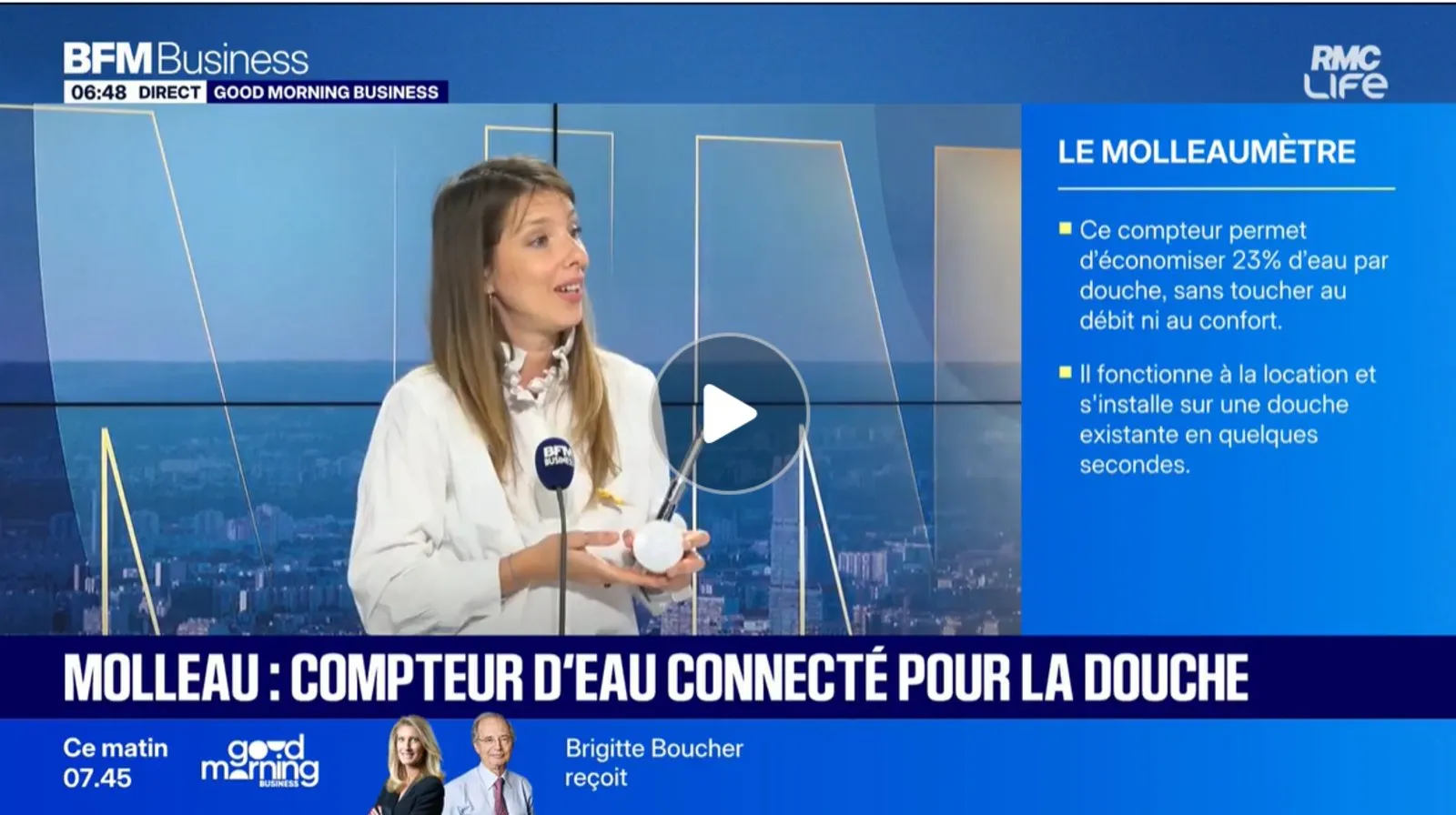
“Up at 4 am, off to the studios. It was my first ever television appearance. Once there, everything moved fast: within ten minutes I was seated. Just before going on, I heard Brigitte Boucher announce Molleau, and something caught in my throat. Four years of work making sense in a single sentence.”
Nobody ever counts the litres
In the shower, every minute the litres run: one minute is more than 10 litres. Nobody counts the litres.
That is exactly where the subject lies. The shower is the largest single use of hot water in a home, it repeats every day in almost every household, and yet it stays entirely invisible while it is happening.
The Molleaumètre makes the shower legible, and does so for the first time: a number climbing in real time in front of you, and a light ring that changes colour as consumption rises. Green, amber, red.
A connected, self-powered shower flow meter that measures water use in real time and displays it during the shower. Powered by a hydroelectric micro-turbine, so battery-free and maintenance-free, it installs in seconds, with no building work and no plumber.
Green up to 20 litres, red beyond 40
The first question from the studio was about the threshold: at what point does the colour change? The ring goes from green to amber at 20 litres, then to red beyond 40 litres, with a pulse of light to signal the overshoot. These are the defaults we chose, and they are configurable: it is for the manager to decide what suits their property, not for us.
A ring, an app and a dashboard
The device does not stop at the light ring. An app supports each resident with everyday water-saving habits, giving them the perspective the ring alone cannot offer: their trends, their volumes, how one week compares with the next. And on the management side, a dashboard brings it all together: consumption by home and by site, conversion into euros and CO₂, and exports ready for CSR reporting.
That dual reading is what separates a measurement from a gadget. Residents see what they use at the moment they use it. Managers see the effect across their whole portfolio, period after period.
Eight months of measurement, not a promise
The figure presented on air comes from the field: in the pilot run with Hénéo (RIVP group, Résidence Relais d'Italie, Paris), eight months of testing and 3,140 showers analysed from November 2025 to June 2026 show a fall of 23% in hot water per shower on average. The maximum individual reduction observed reaches 61% among the heaviest users.
Nothing cut off, nothing imposed. Neither flow nor pressure was changed, and no instructions were given to residents. Simply by showing.
40 litres, is that really a lot?
This was the question that came back most insistently in the studio. Molleau's answer: the French average stands at 60 litres per shower, and that is a lot.
Drought orders and usage restrictions multiply every summer, as summer 2026 showed. The day you have to stay within a limited water allowance, knowing how much you are using at the moment you use it changes everything. Today, in the shower, nobody knows.
“Isn't that stressful?”
That was the question that came up on air, and it is the right one: does displaying a number that climbs while you wash not add pressure? The answer came from the residents themselves. At the six-month review of the pilot, median satisfaction reached 5 out of 5, and every respondent recommends the device.
What they describe is not a constraint but a reference point: something that lets them use water responsibly without thinking about it constantly. The words that recur in the surveys are “benchmark”, “awareness”, “taking responsibility”. That is the whole difference between informing and constraining: nobody is cut off, nobody is judged, everyone decides.
A boost, not just a prompt
One clarification is needed after the programme, because the two ideas are often confused. There is much talk of gentle prompting. Molleau belongs rather to the boost family (Hertwig & Grüne-Yanoff, 2017): where a prompt steers the choice without the person realising, a boost gives them the means to decide for themselves. That is exactly what the Molleaumètre does: the litres run in real time, the ring turns from green to red. One number, one colour, one informed decision.
And the difference is not theoretical: what is learned stays. A student leaving the Hénéo residence where the trial was run said as much on his way out.
“In my next flat, thanks to Molleau, I will know that every minute means a lot of litres.”
That is the promise of a boost: the competence acquired leaves with the person, even when the device stays on the wall.
What it costs, and how it pays for itself
The business model question came up naturally. Molleau works with a fixed set-up fee, then a subscription of around €6 per month per shower covering the device, the dashboard and the app. No sale of bare hardware: the service and the data go together.
For the manager, the return reads on two lines of the bill, the water and the energy that heats it, and on a third, less immediate but no less structural: reporting. The dashboard produces the water and energy savings reports required by the French Éco Énergie Tertiaire scheme and by CSR obligations. In other words, the data is not resold, it serves to document the performance of the property that produces it.
A question of eco-design was also put to us on air, and it is a fair one: an electronic object carries an environmental cost of its own. A life-cycle assessment is under way, and we will publish its results.
What comes next: Orsay, hospitality, a funding round
The next steps were also announced on air. From this autumn we are starting a rollout in a Colonies residence in Orsay with in'li (Action Logement group). A hotel will follow, our first site in hospitality after the residences.
In hospitality the logic shifts slightly: guests do not pay for the water in their shower. That is why room-level measurement opens the way to a reward mechanism, along the lines of what already exists for towels. Recognising the most frugal guests rather than lecturing them, and making the green habit a positive part of the stay.
In parallel, Molleau is preparing a €500,000 funding round before the end of the year, with three objectives: accelerating commercial rollout, clearing the industrialisation phase and strengthening the app dedicated to everyday water-saving habits.
Landlords, student residences, hotel operators: we are opening new pilot sites this autumn. Investors, if the subject speaks to you too, get in touch. Thirty minutes is enough to see whether your situation fits.
Why this appearance matters
Molleau usually speaks to professionals: landlords, residence managers, hotel operators, sustainability teams. They are the ones equipping dozens or hundreds of showers, and therefore the ones who create the impact. But the subject itself is universal. Everyone takes a shower, and nobody knows what it costs.
Speaking to a general audience has this value: it lifts water restraint out of the register of constraint and brings it back to something concrete and measurable. Nobody is being asked to wash less. We make visible what was not, and let each person decide.
What remains is to find out what it would mean for you. The savings calculator gives a first estimate in a few minutes, and all the measured data is published on the key figures page.
Our thanks to the whole BFM Business team, to Brigitte Boucher, and to Clara Bideau and Thomas Chenel for the invitation.
Source: Le Pitch, Good Morning Business, BFM Business, 25 August 2026, interview with Brigitte Boucher. Figures cited: Molleau x Hénéo pilot, RIVP group, Résidence Relais d'Italie, Paris, 28 homes equipped, around 3,140 showers analysed from November 2025 to June 2026, 23% less hot water per shower on average, maximum individual reduction observed 61%. Default thresholds: amber at 20 L, red beyond 40 L, configurable. Indicative pricing: a fixed set-up fee then a subscription of around €6 per month per shower, device, dashboard and app included.