
Claiming savings is easy. Proving them is harder. Here is the two-phase protocol that lets us isolate the real effect of the Molleaumètre, a self-powered shower flow meter with colour-coded visual feedback, deployed in a concrete case: the Hénéo pilot at the Résidence Relais d'Italie in the 13th arrondissement of Paris.
A Molleau field study run with Hénéo (RIVP group) at the Résidence Relais d'Italie, in the 13th arrondissement of Paris. 28 homes equipped, 28 analysed, from November 2025 to June 2026, across 3,140 showers. A two-phase method: silent measurement to set the baseline, then activation of the light ring. Result: 23% less hot water per shower and 15.5% less on the main meter, an entirely behavioural effect, with no change to flow or pressure. 24 of the 28 homes reduced their use (median 17% less), with reductions of up to 61% observed among the heaviest users, amounting to around 20 m³ saved in six months. The effect lasts, with no sign of habituation (consumption stable, p = 0.87). On perception: 83% of residents reported a new awareness and 100% of respondents recommend the device (median satisfaction 5/5, mean 4.4/5).
The Molleaumètre is installed in every room from the outset, but the light ring stays off for several weeks. Consumption measured in the silent phase therefore already includes the effect of knowing a sensor is present, which means the drop observed once the ring is switched on can be attributed to the visual feedback itself, not merely to the presence of the device. That drop is 23% less hot water per shower, and 15.5% on the building's main meter.
For several weeks, the Molleaumètre silently records every shower. No visual feedback is given to the resident. This is the calibration phase: establishing real average consumption, room by room and by time of day.
Without changing flow or pressure, the visual feedback is simply switched on: the ring turns green, then amber, then red. That signal is the only thing that changes. Consumption falls lastingly, and the effect is strongest among the heaviest users.
The curve shifts to the left: showers in the red zone (over 40 L) fall from 48% to 33%, those above 60 L from 23% to 14%, while the amber zone (20 to 40 L) grows from 28% to 41%.
A rollout at the Résidence Relais d'Italie, operated by Hénéo (RIVP group) in the 13th arrondissement of Paris. 28 homes equipped, 28 analysed, monitored continuously from November 2025 to June 2026. It was the first time the silent and active protocol was applied across an entire site.
The Molleaumètre screws straight onto the mixer tap or the shower head, with no building work and no change of fittings. Here are a few installations photographed in the residence during the pilot.
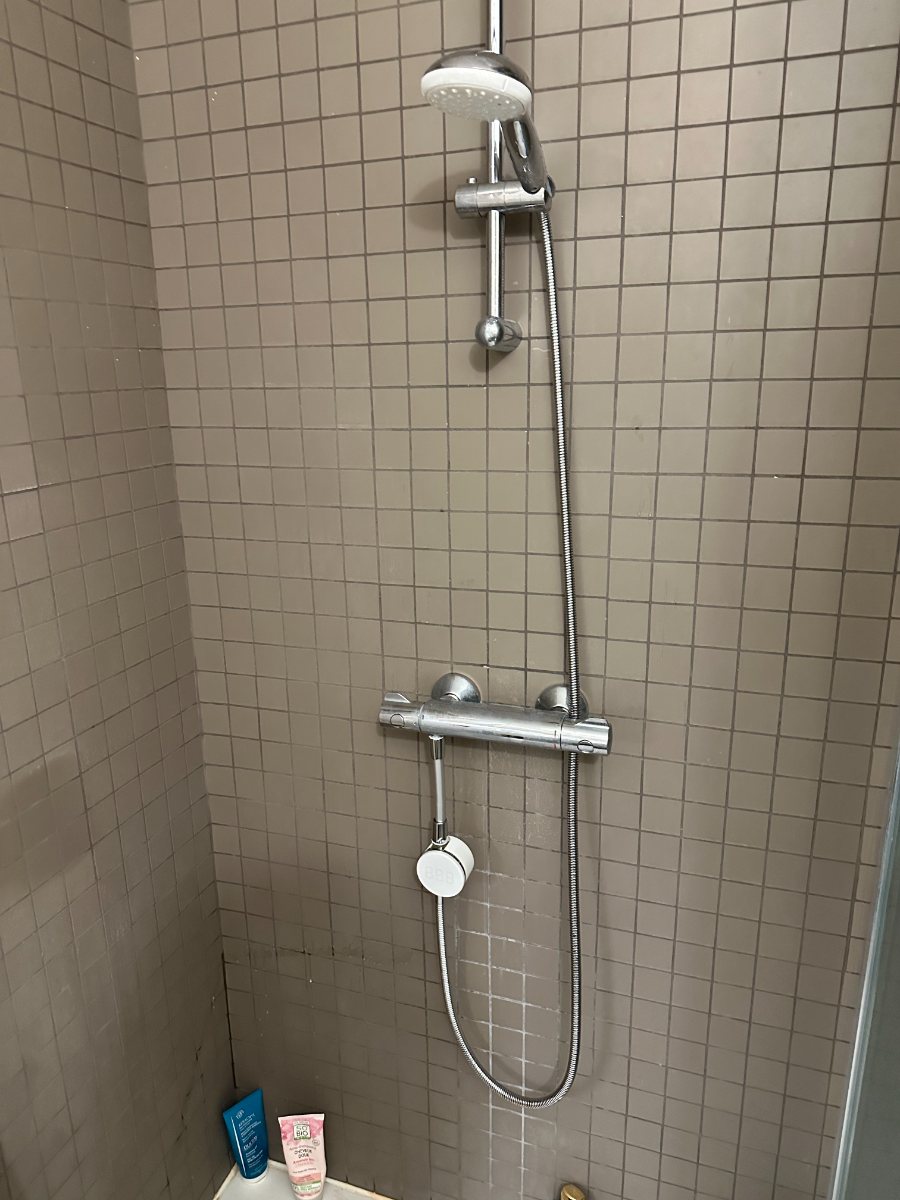
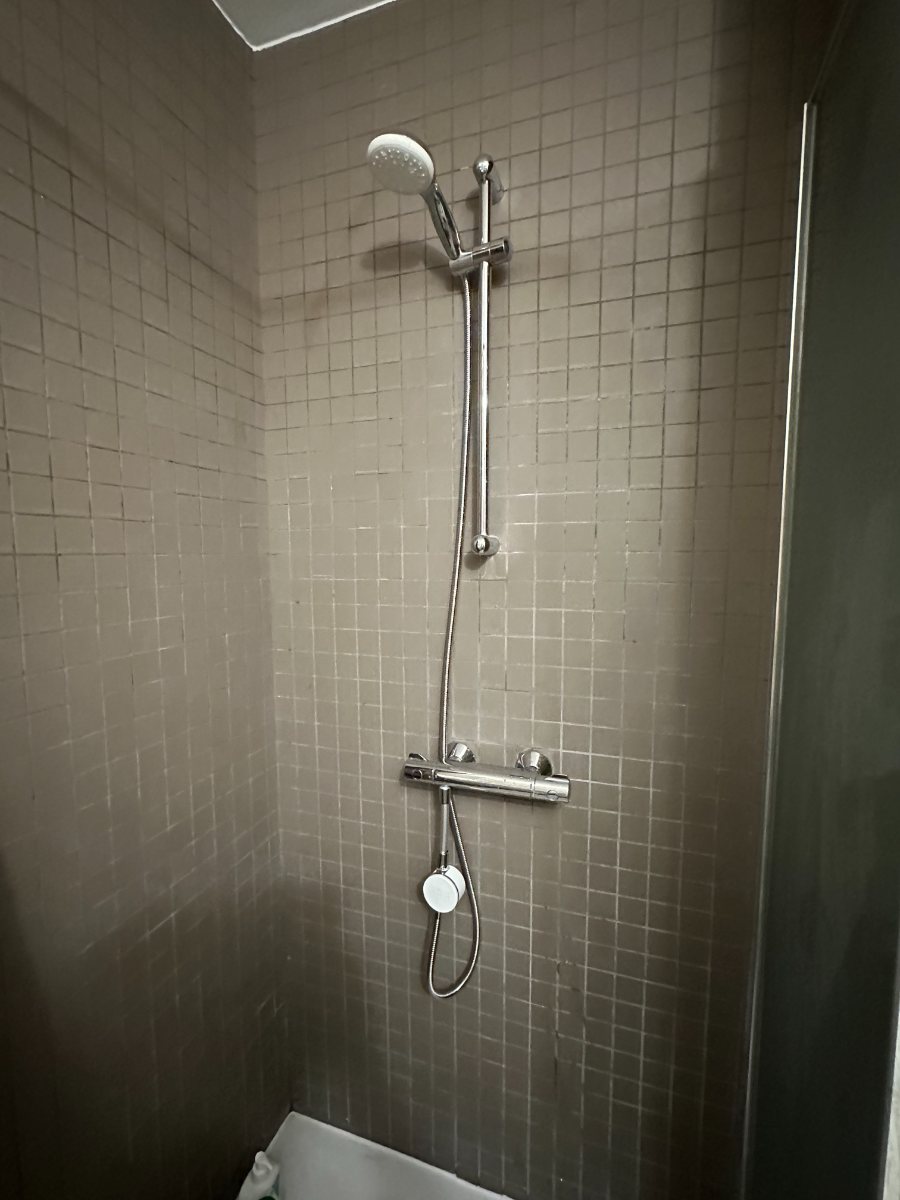
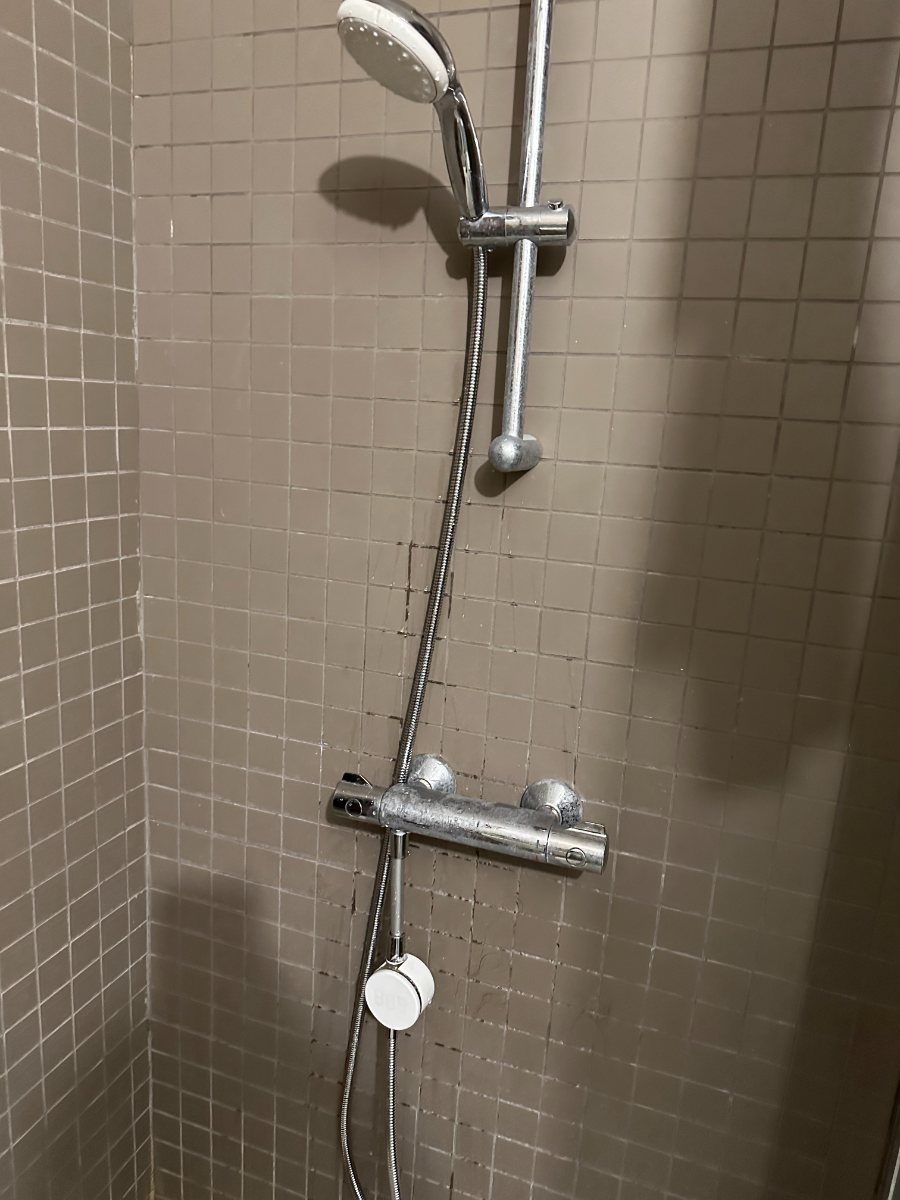
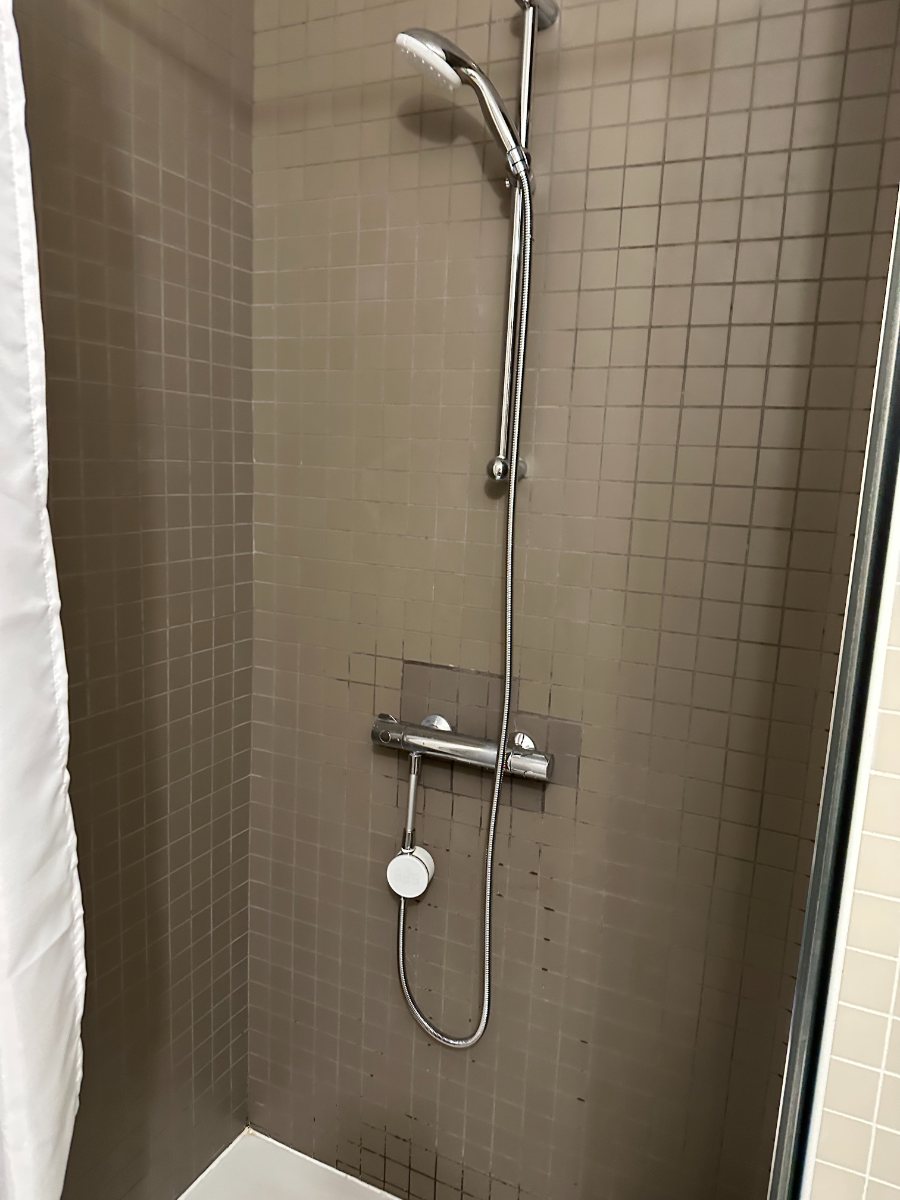
Installations photographed at the Résidence Relais d'Italie (Hénéo · RIVP), Paris 13th arrondissement.
Beyond the litres, three surveys (week 1, one month and six months) gathered how equipped residents felt about it. The figures below come from the one-month survey (6 respondents) and the six-month review (7 respondents).
“Seeing the litres right there in front of you is a real wake-up call.”
Resident · one-month survey“A reference point that teaches me how much I use. The shower becomes a more mindful moment.”
Resident · one-month survey“A genuinely useful everyday help. A really good initiative.”
Resident · six-month review
“The device works as a reminder: it helps us become aware of how much we use, until the habit becomes a good one.”
All measurements are taken at the sensor and anonymised at source. No personal data is captured, only water use behaviour.
The cumulative volume of water used in each shower, accurate to the litre.
Actual running time and average instantaneous flow, to tell long showers apart from high-pressure ones.
The share of green (under 20 L), amber (20 to 40 L) and red (over 40 L) showers, the dashboard's key indicator.
Inform rather than constrain. The Molleaumètre draws on behavioural science and on boost theory (Hertwig & Grüne-Yanoff, 2017): giving people the information and reference points to decide for themselves, at the right moment, is enough to shift behaviour lastingly.
1. Immediate feedback. Residents see their consumption in real time. Not afterwards, not on a bill three months later, but at the precise moment they can act on it.
2. An intuitive benchmark. The colour code (green, amber, red) instantly turns litres into a clear reference point: one glance is enough to see where your shower stands. This is the principle of natural frequencies, presenting information in a form the mind grasps immediately, so the decision follows naturally.
3. Autonomy preserved. No reduced flow, no timer, no cut-off. Residents stay fully in control, and it is precisely because the change is chosen that it lasts.
Download the full Hénéo pilot report: protocol, anonymised raw data, methodology and resident feedback.