
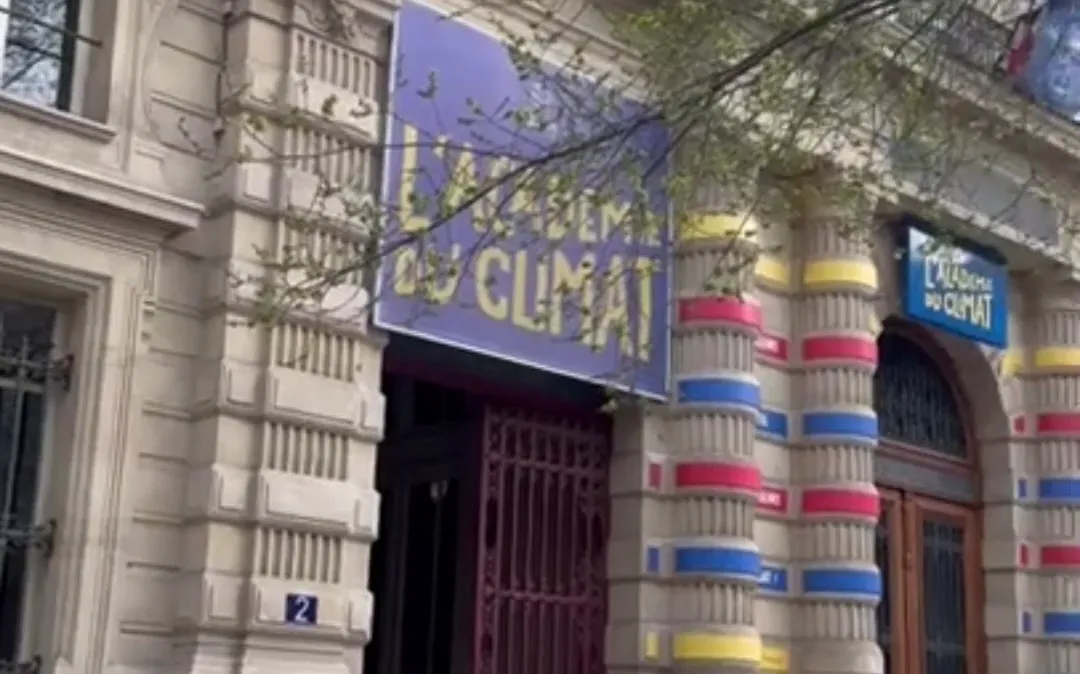
The Water Fresk (Fresque de l'eau) is a collaborative workshop of about 3 hours, distributed by the French association Eau'Dyssée. In tables of 4 to 8, participants connect about fifty cards to rebuild the natural water cycle, the cycle created by human activity, the impacts of that activity and the effects of climate change, then discuss solutions. At Molleau we are trained to run it and do so from time to time, in companies or in public venues such as the Académie du Climat in Paris. Here is how a session unfolds.
Source: Eau'Dyssée, "La Fresque de l'eau", page consulted 30 October 2026; workshop leaflet distributed by the agricultural education water network.
What is the Water Fresk?
The Water Fresk is a collaborative card game that gives an overview of freshwater issues in our societies, built on verified scientific sources. It was created by Laurie Caillouet and Sébastien Legrand, and the Eau'Dyssée association distributes it through its network of facilitators. The principle is that of educational "fresks": rather than a lecture, participants build the reasoning themselves, card after card, looking for cause-and-effect links. The result is a large fresco laid on the table, which the group has drawn and can explain.
The workshop is aimed at adults, whether or not they already know the subject. Eau'Dyssée also offers themed mini-games, for instance on the Aral Sea, eutrophication or droughts, and mini-games on domestic and agricultural water uses, which allow a shorter or more specialised session.
How does a Water Fresk workshop unfold?
A workshop unfolds in four successive card sets, then a discussion. Here is the thread we follow when we run it.
- Welcome and framing. We present the principle, the rules and the question guiding the session: where does the water we use come from, and where does it go? Each table receives a large blank sheet, markers and the first set of cards.
- Set 1, the natural water cycle. Evaporation, precipitation, infiltration, aquifers, rivers, oceans: participants place the cards and draw the arrows. It is the common base, and often where the first surprises come, on the share of freshwater actually available.
- Set 2, the human water cycle. Abstraction, treatment, distribution, uses, sanitation, discharge. The group discovers that abstracted water does not always return where it was taken, nor in the same state.
- Set 3, uses and impacts. Agriculture, industry, energy, domestic uses: the cards link each use to its effects on the resource and on ecosystems, and the group rebuilds the timeline of human impacts.
- Set 4, climate change. Droughts, intense rainfall, melting glaciers, rising seas: the last series shows how the climate disrupts the two cycles already on the table.
- The discussion. Once the fresco is complete, each table presents it, then the discussion turns to what everyone can do, individually and collectively. That is when everyday habits come up, and the shower in particular.
Why does Molleau run Water Fresks?
Because the fresk and the Molleaumètre answer two complementary needs: understanding, then acting. The fresk gives the big picture, scarce freshwater, disrupted cycles, the share of domestic uses. The Molleaumètre acts at the precise moment of consumption, in the shower, by displaying litres in real time. In the pilot run with Hénéo on 3,140 showers, that simple display cut the average shower from 45 to 34.7 litres, −23%, and up to −61% among the heaviest users.
We run the fresk from time to time, at the request of companies, landlords, hoteliers or awareness venues. It is not a commercial activity: the session follows Eau'Dyssée's format, with no product presentation. It is, however, an excellent prelude to a Molleaumètre roll-out in a residence or a hotel, because teams and occupants then understand why the light ring changes colour.
How to take part in or organise a Water Fresk?
To take part, the simplest is to check the calendar of public workshops on the Eau'Dyssée website, which lists sessions run by facilitators across France. To organise a session in your organisation, you can contact the association directly, or write to us at equipe@molleau.com if you would like Molleau to run it: you need a room, one large table per group of 4 to 8 people and about 3 hours. To become a facilitator, Eau'Dyssée asks that you first take part in a workshop, then follow a short training.
| Format | Length | Participants | For whom |
|---|---|---|---|
| Full workshop | about 3 h | 4 to 8 per table | teams, local authorities, general public |
| Two half-sessions | 2 × 1 h 30 | 4 to 8 per table | companies, when 3 hours in a row are difficult |
| Short or quiz version | variable | 4 to 8 per table | events, trade shows, first contact with the subject |
Formats described by Eau'Dyssée on the workshop presentation page. Practical conditions (any fee, materials) are to be agreed with the association or the facilitator.
What would it mean for you?
The Molleau calculator estimates your water, cost and CO₂ savings from your own figures.
The Water Fresk is a collaborative workshop of about 3 hours, distributed by the Eau'Dyssée association, where tables of 4 to 8 participants rebuild with about fifty cards the natural water cycle, the human cycle, the impacts of uses and the effects of climate change, before a discussion on solutions. Molleau runs it from time to time, alongside the Molleaumètre which then acts in the shower. Source: Molleau, molleau.com, from Eau'Dyssée.
Frequently asked questions
How long does a Water Fresk last?
About 3 hours for the full workshop: four card sets then a discussion. Eau'Dyssée indicates the session can be split into two 1 h 30 sessions or shortened as a quiz or a focus on one type of impact.
Do you need to know the subject to take part?
No. The workshop is aimed at adults, whether or not they already know water issues. The cards bring the facts, and the group builds the reasoning with the facilitator's help.
Who created the Water Fresk?
The Water Fresk was created by Laurie Caillouet and Sébastien Legrand. The Eau'Dyssée association distributes it and trains facilitators. Its website shows close to 14,000 people reached at 28 October 2026.
Can Molleau run a Water Fresk in my company or residence?
Yes, from time to time and depending on availability. Write to equipe@molleau.com with the venue, the number of participants and the dates you have in mind. You need a room, one large table per group of 4 to 8 people and about 3 hours.
Sources: Eau'Dyssée, "La Fresque de l'eau" (creators, length, formats, number of cards, participant counter, page consulted 30 October 2026); workshop leaflet distributed by the agricultural education water network (group size, four card sets, learning objectives); Carenews, "9 fresks to know" (updated 9 January 2025). Reduction results: Molleau × Hénéo pilot, RIVP group, Relais d'Italie residence, 3,140 showers, November 2025 to June 2026 (full protocol).