
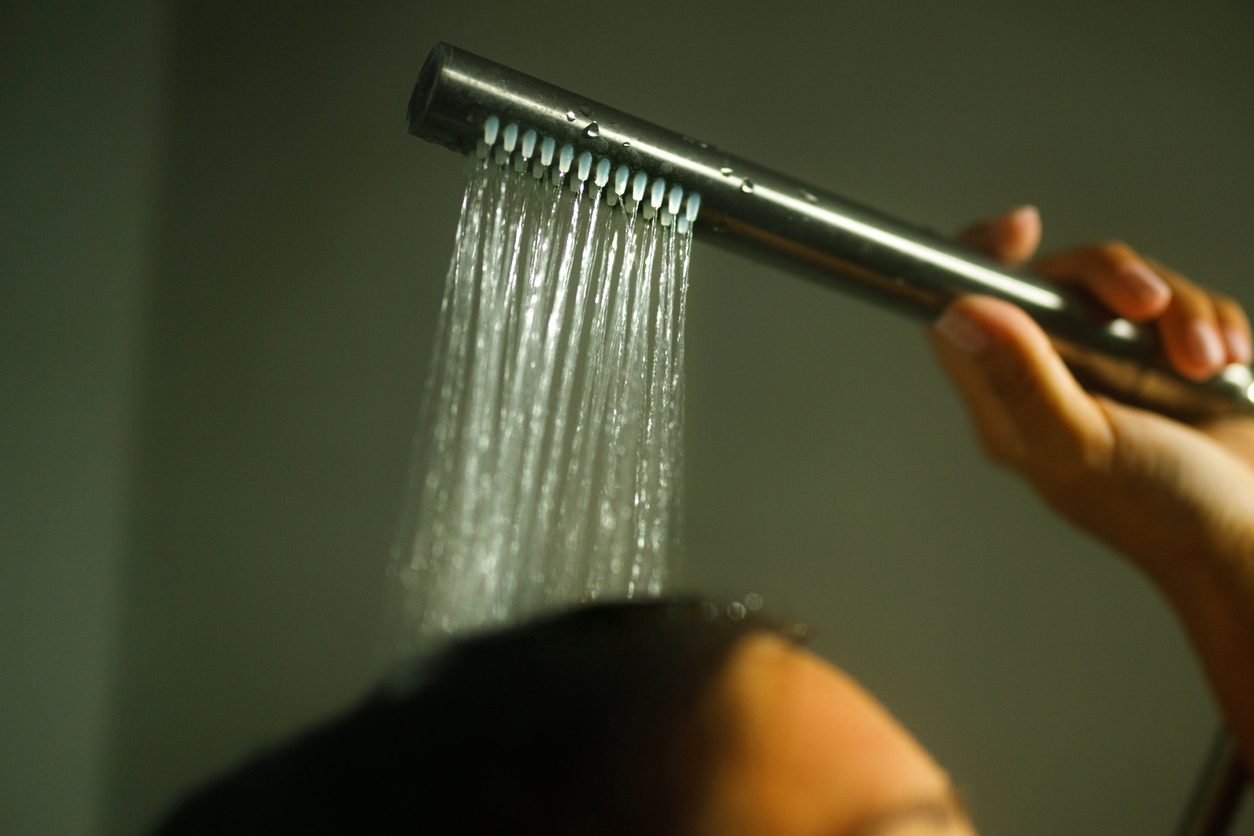
Cutting a hotel's water use is often assumed to mean major building work. In practice the most effective lever lies elsewhere: the shower, the largest single source of consumption, accounts for at least 100 litres per guest per night and up to 60% of the property's water use (French Directorate General for Enterprise, 2024). It is also the fastest thing to act on, without necessarily changing guest comfort at all.
Set a baseline before acting
The water bill gives you a total volume, with no indication of which room used what, or when. The first step is to establish a baseline in litres per occupied night (annual consumption divided by the number of room nights). The expected range is 240 to 323 litres per night depending on the segment, across all uses, of which around 150 litres is domestic water used in the room by the guest (see our article How much water does a hotel room use per night?). Measuring room by room adds a further level of detail: with identical fittings, two rooms can differ substantially depending on guest habits. That is where the main savings lie.
The shower: the first lever
Three things make the shower the priority. It is the largest single use of water in the room, reaching up to 60% of the hotel's consumption (French Directorate General for Enterprise, 2024). It is heated water, so every litre avoided also saves around 0.03 kWh of energy. And it is the use most sensitive to behaviour: guests do not pay for the water and cannot see the volume, which makes the average shower longer than at home.
Real-time visual feedback acts on exactly that point. A meter with a light ring, fitted to the hose, displays consumption during the shower and changes colour as it rises. No restrictor, no cut-off and no building work are required. In the Molleau x Hénéo pilot, hot water use per shower fell by 23% and by 15.5% on the residence main meter (up to 61% observed among the heaviest users), with no instructions given to anyone.
Research supports this. A University of Surrey study published in the Journal of Travel Research (Pereira-Doel et al., 2024), covering more than 17,500 showers across six tourist accommodations in Denmark, Spain and the United Kingdom, measured a 25.79% reduction in running time thanks to real-time feedback, equivalent to roughly 10 litres saved per shower.
And in your property?
Thirty minutes to estimate your savings potential. No commitment.
The other levers, by order of effort
Once the shower is dealt with, the following levers consolidate the results.
| Lever | What it does | Effect / caveat |
|---|---|---|
| Real-time feedback in the shower | Light ring on the hose, consumption displayed live | 23% less hot water per shower, measured (up to 61% observed), no building work and no loss of comfort |
| Tap and fitting maintenance | Regular checks for leaks and drips by housekeeping teams | Recovers several m³ lost continuously, at almost no cost |
| Efficient shower heads and aerators | Flow reduced from 12-15 to 6-9 L/min | Real gains, but perception varies: test on a few rooms before rolling out |
| Linen reuse | Offering guests the option to keep towels and sheets | Fewer wash cycles, especially on multi-night stays |
| Technical equipment | Recent commercial washing machines and dishwashers, controlled outdoor irrigation | Gains at property level |
| Major works (greywater or rainwater) | Reuse permitted for non-food uses in France since the decree of 12 July 2024 | Effective, but a significant investment to amortise over the long term |
Recognising frugal guests
Measuring room by room allows something purely mechanical solutions cannot: recognising the most frugal guests. A complimentary drink or a small gesture at breakfast for the rooms that used the least costs very little, brings people into your food and drink areas, and gives your sustainability messaging something concrete to stand on. The principle and its safeguards are set out on the water-saving solution for hotels page.
The most profitable lever for cutting a hotel's water bill needs no building work: making consumption visible during the shower delivers a measured saving of 23% per shower (up to 61% observed among the heaviest users). Regular maintenance of taps and fittings, and flow reduction tested beforehand, round out the approach. Estimate your potential savings in water, money and CO₂ with the Molleau calculator.
Sources: French Directorate General for Enterprise, “Water management in the tourism sector” (September 2024); French decree of 12 July 2024 on the reuse of non-conventional water; University of Surrey (Pereira-Doel et al., Journal of Travel Research, 2024); Molleau x Hénéo pilot, RIVP group (2025-2026).