
A high water bill at a hotel almost always comes from two sources: undetected leaks and shower consumption, the largest use in the room. The first step is to check for leaks, the second is to measure consumption room by room to know where to act. The most effective solutions for the shower require no building work and no loss of comfort.
Where a hotel's water consumption comes from
According to the French Directorate General for Enterprise, a hotel uses on average 240 litres of water per person per night in the one to three star segment, and 323 litres in four and five star hotels, across all uses. Cleaning rooms and bathrooms accounts for 40 to 45%.
In the room, the shower is the largest use: it can account for up to 60% of the property's water consumption. Nationally, tourism withdraws 335 million cubic metres a year in France, 59% of it for accommodation, as Le Figaro reported. It is also the most expensive, because this is heated water: every litre weighs on both the water bill and the energy bill. And it is the only use the operator cannot control, since shower length depends on the guest. The full figures are in our article How much water does a hotel room use per night?
| Indicator | Value | Source |
|---|---|---|
| Consumption, one to three star hotel | 240 L per person per night | French DGE, 2024 |
| Consumption, four and five star hotel | 323 L per person per night | French DGE, 2024 |
| Share used for cleaning | 40 to 45% | French DGE, 2024 |
| Shower share of a hotel's consumption | up to 60% | French DGE, 2024 |
| Annual withdrawals by tourism in France | 335 million m³, of which 59% for accommodation | French DGE, cited by Le Figaro, 2026 |
| Measured reduction with real-time display | −23% hot water per shower on average | Molleau x Hénéo pilot, 3,140 showers |
Solutions ranked by cost and effectiveness
| Solution | Cost | What it changes |
|---|---|---|
| Leak checks by staff | Very low | Removes continuous losses such as a dripping tap or a running toilet. Build it into housekeeping and maintenance rounds. |
| Flow restrictors and aerators | Low | Flow drops from 12-15 to 6-9 L/min. A real gain, but perceived comfort varies: test on a few rooms before rolling out. |
| Thermostatic mixer taps | Medium | Water reaches the right temperature faster, which limits the water wasted at the start of the shower. |
| Awareness signage | Low | A real effect that fades within weeks, for lack of a reference point at the moment of use. |
| Measurement and display per room | Medium | Guests see the litres during their shower, the hotel tracks each room. Acts on behaviour without touching the flow. |
Measure to know where to act
The main meter gives a total volume, read monthly or quarterly. It does not tell you which room uses the most, when, or whether an action has worked. To decide where to invest, you need to measure at the point of use, meaning the shower.
Room-by-room measurement does three things: it reveals gaps between identical rooms, it compares periods to check whether an action has worked, and it puts a figure in euros on the result for management. We describe what good monitoring should show in A water dashboard: tracking consumption room by room.
Where the Molleaumètre fits among these solutions
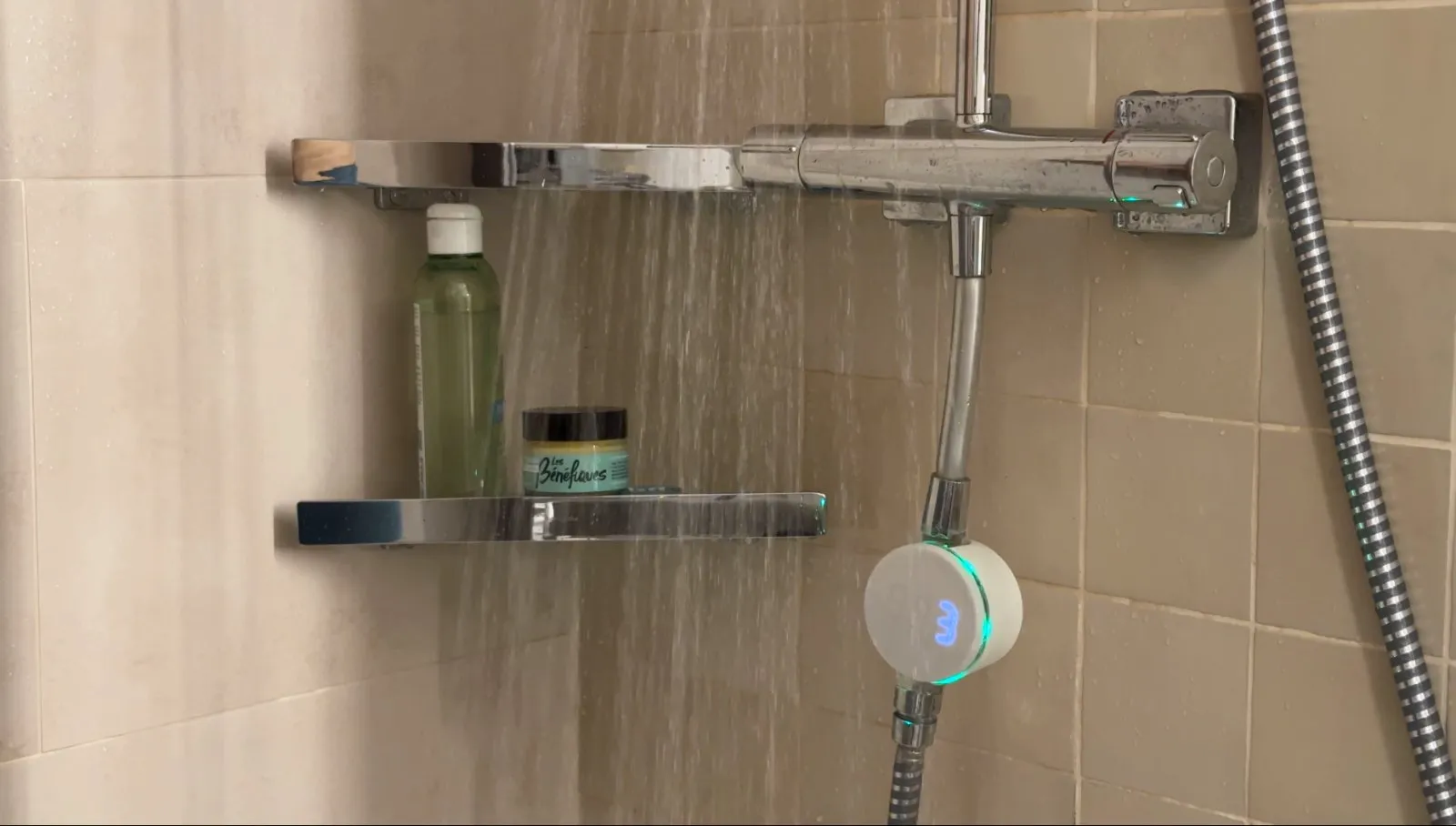
The Molleaumètre belongs to the last line of the table: measurement and display per room. It is a connected water meter that screws onto the mixer tap or the shower hose. It displays the number of litres used in real time, and a light ring changes colour as consumption rises. Flow and pressure stay the same.
The data is sent to a dashboard: consumption by room, by period, in euros and in CO₂. The Molleau team handles installation, with no building work, and a 40-room hotel is equipped in less than a day. In the pilot run with Hénéo in a student residence, 3,140 showers were analysed over eight months: consumption fell by 23% of hot water per shower on average, by 15.5% on the main meter, and by up to 61% observed among the heaviest users.
The Molleaumètre does not replace leak checks, which remain the first thing to verify. It complements the other levers by acting on the one use the hotel cannot control: shower length. The full approach for a property is set out on the connected water meter for hotels page, and the savings calculator gives a first estimate for your property.
Frequently asked questions
Why is my hotel water bill so high?
A hotel uses on average 240 litres of water per person per night in the one to three star segment and 323 litres in four and five star hotels, across all uses (French Directorate General for Enterprise, 2024). The shower is the largest use in the room, up to 60% of the property's consumption, and it is heated water: it weighs on both the water bill and the energy bill.
What is the quickest way to reduce a hotel's water use?
Checking for leaks during housekeeping rounds is the cheapest measure. To act on the largest use, the shower, displaying consumption in real time requires no building work and does not change comfort: in the Molleau pilot with Hénéo, consumption fell by 23% of hot water per shower on average.
How can I tell which rooms use the most water?
The main meter gives a total volume with no breakdown by room. To know where to act, you need to measure at the point of use. The Molleaumètre measures every shower and sends the data to a dashboard: consumption by room, by period, in euros and in CO₂.
Does measuring water use per room require building work?
No. The Molleaumètre screws onto the mixer tap or the shower hose. The Molleau team installs it, with no water shut-off and no plumbing, and a 40-room hotel is equipped in less than a day.
Sources: French Directorate General for Enterprise, “Water management in the tourism sector” (2024); Molleau x Hénéo pilot, RIVP group, Résidence Relais d'Italie student residence, Paris, 28 homes, 3,140 showers analysed over eight months, 23% less hot water per shower on average, 15.5% less on the main meter, maximum individual reduction observed 61%. Shower head flow rates: market orders of magnitude.